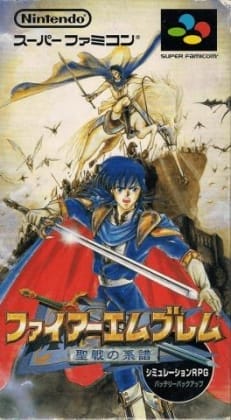

SNES
Fire Emblem: Genealogy of the Holy War
The fourth Fire Emblem game introduces generational gameplay across two sagas. Players lead crusaders' descendants through political intrigue and continent-spanning battles in the kingdom of Jugdral.
Release Date
January 1, 1996
Developer
Intelligent SystemsPublisher
Intelligent Systems
Players
1
Region
US
ROM Size
2.8 MB
Share this game
Story
In the year Grann 757, barbarians from the kingdom of Isaach besiege Darna Castle, and Prince Kurth of Grannvale and his friend Lord Byron of Chalphy set out on a punitive expedition . When the southwestern kingdom of Verdane takes advantage of Grannvale's weakened state to invade, Byron's son Sigurd repels them and launches a counter-invasion to rescue his childhood friend Edain, daughter of the Duke of Yngvi, who was kidnapped, and in the process, he rescues Shannan the prince of Isaach, who was used as a hostage to force his aunt Ayra to fight against Grannvale. During the campaign, Sigurd meets a mysterious girl named Deirdre. She is revealed to be of Naga blood, a long-lost member of the Grannvalian royal family, the House of Belhalla, and the descendant of the crusader with the power to defeat the evil dragon Loptous. Sigurd and Deirdre fall in love and marry, and their son Seliph is born in Agustria. At this point, Dukes Lombard and Reptor conspire to seize the throne of Grannvale, murder Kurth, and frame Sigurd and his father for the crime. Sigurd is forced into exile, while the archbishop Manfroy of the Loptr Church kidnaps Deirdre and erases her memories in order to use her to resurrect Loptous. His plan is to wed her to Lord Arvis of Velthomer — the two are, unbeknownst to them, half-siblings, and their union will produce a human vessel capable of hosting the consciousness of Loptous. During their exile, Sigurd and his allies are forced to hide Seliph and the rest of their children from the forces of Arvis and the cult. After a year in exile, Sigurd starts making his way back through Jugdral, killing the Dukes responsible for the false accusation. Apparently exonerated, Sigurd returns to Grannvale, only to learn that Arvis has married Deirdre to become Grannvale's king. Arvis orders Sigurd's allies to be executed and personally murders Sigurd. Over the next fifteen years, Grannvale expands to hold dominion over the whole of Jugdral, and Arvis styles himself the emperor of Grannvale. He and Deirdre have twin children: Julius, the scion of Loptous, and Julia, the scion of Naga. Manfroy uses the Loptyr tome to corrupt Julius, turning him into Loptous's vessel, while Deirdre sacrifices herself to warp Julia away from Julius. Julius overthrows his father and turns the Empire into a tyrannical regime. At this point, Seliph comes out of hiding to protect a nearby village, revealing his long-hidden existence to Grannvale. Traveling across the lands of Jugdral, Seliph joins forces with the long-hidden children of Sigurd's companions, as well as Julia. Making his way through the countries of Jugdral, he gains support from the surviving powers, and gradually frees Grannvale's conquered territories. Arvis is powerless to subvert his son's rule, and is killed in battle against Seliph. During the course of these battles, Julia is captured and Manfroy and Julius attempt to sacrifice her, as her powers could banish Loptous for good. Seliph manages to save her, and after defeating Manfroy and Julius in battle, Julia successfully banishes Loptous, finally ending his rule and allowing Jugdral to recover from the recent conflicts. Seliph takes his rightful place on the throne as the emperor of Grannvale, and restores power to the surrounding countries with their respective heirs.
Gameplay Systems
Fire Emblem: Genealogy of the Holy War is a tactical role-playing game in which the player takes the roles of Sigurd and his son Seliph across a variety of story-driven missions on the continent of Jugdral. The story is divided into chapters, which are in turn divided between two generations of characters. Before and during missions, the player units may settle in a home base, where various actions can be taken such as repairing weapons, buying and selling items, and participating in arena battles. Castle towns within mission maps can also be visited for similar services. Battles play out using a turn-based system where each unit on both sides is given their chance to move and act. Characters move and attack within the same turn, and in a few cases units can take two moves in a turn. A key part of combat is the Weapon Triangle, a new addition to the series which governs the opposing strengths and weaknesses of weapon types based on a rock–paper–scissors system - lances are stronger than swords, swords are stronger than axes, and axes are stronger than lances. A secondary system governs the magic system, where Fire, Lightning, and Wind spells have varying strengths and weaknesses against each other with Light and Dark magic existing outside of the magic triangle whilst having an advantage over the elemental magic types. Each unit has a character class which determines their weapons, movement, and which skills they possess. Weapon types also affect battle performance: for instance, axes deal more damage, but weigh characters down more than swords. The actions taken in earlier parts of a map can affect later parts of that mission, triggering scripted changes in objectives and enemy behavior: for instance, when a castle is seized, the neighboring castle will deploy additional troops. After each battle, a player character gains experience points . When a unit gains 100 experience points, they receive random boosts to their statistics such as health, strength and speed. All characters, with the plot related exceptions, are subject to permanent death if they are defeated in battle, removing them from the rest of the game. If the army's leader is killed or the player's home castle is seized by the enemy, the map must be restarted from a save file , which can be written to at the start of every turn. Victory is achieved upon capturing a specific castle on the map. Character relationships form a core part of gameplay, and include both optional conversations and story-driven character romances. Conversations see selected characters in the mission map talking with each other, and some romances are triggered by the story when certain characters have joined the party during the first generation storyline. The second generation units have their stat values and personal skills influenced by the assigned attributes of their parents. Second generation units can also form optional romantic attachments, but this only allows stat-increasing conversations. When siblings or married characters are next to each other, they grant a critical hit boost to each other. Married characters can also give their gold to each other if they're next to one another, while thieves can give their gold to any adjacent character, regardless of relationship status. In addition to normal stat growth, some high-ranking units on both sides have a separate "Leadership" rank, which grants stat boosts to all units within three tiles, with the boost increasing with that unit's Leadership rank.
Media Reviews
Famitsu
9/10
Nintendo Power
2013
Some information sourced from Wikipedia, available under CC BY-SA 3.0.